


Question

Is p-rc-session-id received from ringcentral-softphone-ts package invite headers unique everytime?

  • August 17, 2026
  • 3 replies
  • 27 views

I have configured multiple softphones using https://github.com/ringcentral/ringcentral-softphone-ts package. On invite event of the call, I get the following information in header:
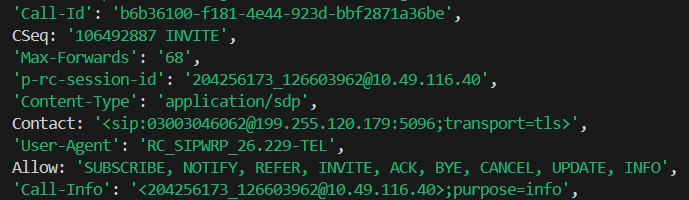
 

Since we can not receive telephony id until the call is answered, we would like to use a unique identifier as p-rc-session-id. Can we confirm if the p-rc-session-id repeats or not? Or we can save it as unique in the database?

3 replies

PhongVu
Community Manager
Forum|alt.badge.img
  • Community Manager
  • August 17, 2026

I believe that the p-rc-session-id is unique and won’t be repeated. However, the format are different for different type of calls.

E.g.

PSTN to : '275520245_49745652@10.115.152.11'

VoIP to VoIP: '0050425d-124d-4143-b342-c2958da1c194'


@PhongVu Thank you for answering.

Another things I wanted to confirm.

Our softphone implementation performs a blind transfer, where the call returns to the same softphone if the transferred agent does not answer or rejects the call. This behavior is configured through the transferred agent’s Incoming Call Handling settings.

However, when a human user transfers a call to the same agent, they perform a warm transfer. In this scenario, because the agent’s Incoming Call Handling is configured to return unanswered/rejected calls to the softphone, the human user expects to hear the “User not available” audio instead of having the call routed back to the softphone.

How can we configure RingCentral to achieve both behaviors?

  • Blind transfer: If the transferred agent does not answer or rejects the call, return the call to the originating softphone.

  • Warm transfer: If the transferred agent does not answer or rejects the call, play the agent’s “User not available” message rather than routing the call back to the originating softphone.

Is there a way to differentiate the call handling behavior based on whether the transfer was initiated as a blind transfer or a warm transfer through RingCentral’s setting or programatically?


PhongVu
Community Manager
Forum|alt.badge.img
  • Community Manager
  • August 17, 2026

@PhongVu Thank you for answering.

Another things I wanted to confirm.

Our softphone implementation performs a blind transfer, where the call returns to the same softphone if the transferred agent does not answer or rejects the call. This behavior is configured through the transferred agent’s Incoming Call Handling settings.

However, when a human user transfers a call to the same agent, they perform a warm transfer. In this scenario, because the agent’s Incoming Call Handling is configured to return unanswered/rejected calls to the softphone, the human user expects to hear the “User not available” audio instead of having the call routed back to the softphone.

How can we configure RingCentral to achieve both behaviors?

  • Blind transfer: If the transferred agent does not answer or rejects the call, return the call to the originating softphone.

  • Warm transfer: If the transferred agent does not answer or rejects the call, play the agent’s “User not available” message rather than routing the call back to the originating softphone.

Is there a way to differentiate the call handling behavior based on whether the transfer was initiated as a blind transfer or a warm transfer through RingCentral’s setting or programatically?

A blind transfer is completely different from a warm transfer.

For a blind transfer, the system “forwards” a call to the transferred destination and terminate the call immediately regardless of the destination answers or rejects or not available. Thus, there is no way to return the call to the transferrer.

For a warm transfer, the transferrer puts the active call on-hold, makes a new call to the transferred destination, then “bridge” the calls. If the transferred destination does not answer, the active call is still in on-hold and can be resumed by the transferrer.